Загрузка ...
Modern and unusual living room designs for a country house ideas and examples
The living room in a country house is the center of family life and a place where it is especially important to combine comfort, functionality and expressive aesthetics.
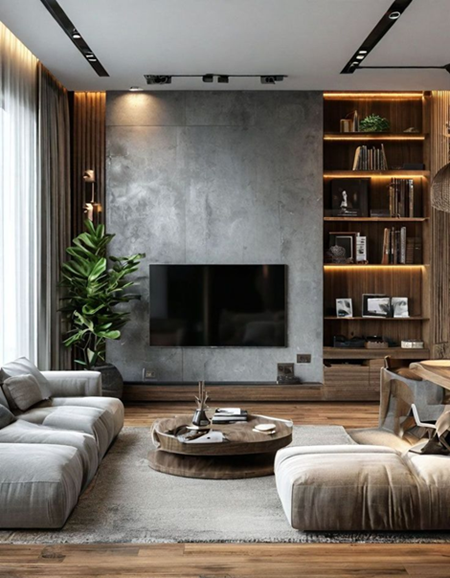
Modern solutions are based on open layouts, thoughtful zoning and natural materials, while unusual ones are based on bold combinations of textures, accent colors, non-standard forms of furniture and designer lighting arieteart.com.
This article contains ideas that will help you create a unique interior: from minimalism with panoramic windows to eclecticism with art objects and a fireplace as the compositional core. If you need a project that takes into account the architecture of the house, family habits and budget, you can order a design on the https://www.arieteart.com/ and receive a solution adapted to your format of country life.
Fireplace as an art object: non-standard portal options and safe finishing
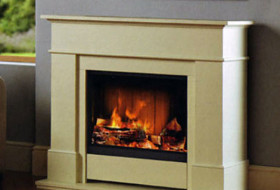
In the modern living room of a country house, the fireplace is increasingly becoming not a “comfort corner”, but a central installation: it sets the composition, scale and character of the space. A non-standard portal allows you to turn the hearth into a sculptural accent — from a laconic monolith to a bold asymmetry that works as an independent work of art.
But the more expressive the form, the more important is thoughtful safety: correct gaps, non-combustible materials and correct connections to walls and floors. The fireplace portal should not only impress, but also withstand temperature, not emit harmful substances and remain resistant to microcracks and dirt.
Custom portals: when a hearth becomes a sculpture
One of the spectacular options is a monolith portal, where the cladding looks like a solid “stone” that extends onto part of the wall or ceiling. This technique works well in living rooms with high ceilings: the fireplace visually “stretches out” the space and forms a vertical dominant.
For interiors with an open plan, expressive are two-sided and three-sided fireboxes, which read like a glass “lantern” and at the same time divide zones without partitions. And in minimalism and Japanese aesthetics (Japandi), thin portals with an emphasized line of fire, where only the opening and the texture of the finish remain visible, look impressive.
If you want a more artistic gesture, choose an asymmetrical portal with a “shelf” for decor, an integrated niche for firewood or a graphic protrusion that works as a podium for objects. In a country house, “natural” solutions are also appropriate: a portal made of relief stone or hand-molded brick, but in modern geometry and with neat seams.
Safe finishing begins with materials that are designed to withstand heat and do not support combustion. For expressive but practical portals they often use:
- porcelain tiles and large-format ceramics (stable geometry, temperature resistance, minimum seams);
- natural stone (granite, slate) or stone veneer on a non-combustible basis — with the correct selection of glue and base;
- microcement and mineral decorative coatings, if they are certified for heating zones and applied in the correct layer system;
- metal (steel, brass) as a screen or accent frames — it adds graphics and a “gallery feel” to the image;
- fire-resistant boards (calcium silicate, magnesite, gypsum plasterboard) as a base layer for finishing.
Living room-studio with kitchen: camouflage of equipment and a single palette of materials — the result
The single space of a living room-studio in a country house looks integral when the kitchen does not “stand out” as a separate block, but supports the overall character of the interior. This is achieved through visual silence: laconic lines, closed facades, a minimum of disparate textures and neat integration of household appliances.
The disguise of equipment and a unified palette of materials work together: the first removes household “noise”, the second connects the zones into one composition. As a result, the living room remains the main scenario for relaxation and communication, and the kitchen remains a functional part without undue attention to processes and devices.
What captures the modern, unusual and solid result
- Technology “disappears”: built-in, matching facades, hidden hoods, a single line of cabinets without visual breaks.
- The materials are repeated: one dominant shade and 1-2 accent textures (for example, wood + stone/ceramic granite) in both zones.
- Seamless transitions: the same logic of verticals and horizontals, matching levels and rhythm of modules.
- The accents are dosed: expressive details (lighting, textiles, art) are in the living room area, and a calm background in the kitchen.
- Practicality goes hand in hand with aesthetics: washable surfaces and durable finishes look like part of the design, not a compromise.
Result: a living room-studio with a kitchen becomes truly modern and unusual not due to decorative overload, but thanks to thoughtful camouflage of equipment and strict coordination of materials that transform two functional worlds into a single interior image.