Загрузка ...




Direct-to-Garment (DTG) Printing on Heavyweight Unbleached Cotton and Canvas Textiles: Fibre Flattening and Platen Clearance
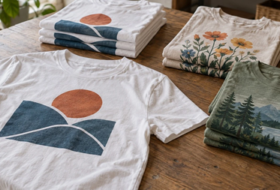
When garment decorators and sustainable merchandise suppliers print directly onto heavyweight unbleached cotton tees, raw ecru sweatshirts, and woven cotton canvas tote bags, commercial direct-to-garment (DTG) printing requires three distinct parameter adjustments compared with standard combed jersey shirts: higher heat-press smoothing pressure to flatten coarse surface slubs, careful Z-axis printhead clearance over thick seams, and calibrated pre-treatment absorption on natural cotton fibres.
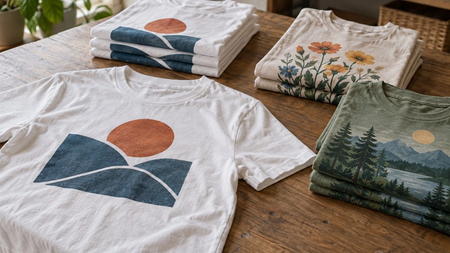
For print shops expanding into eco-conscious retail bags, heavyweight street-wear cotton blanks, and natural home textiles, adjusting shop-floor protocols for coarse cotton weave prevents head strikes and washed-out prints.
How Unbleached Raw Cotton and Woven Canvas Differ From Standard Jersey Knit
A standard 180 GSM bleached combed ring-spun T-shirt has gone through scouring, bleaching, and singeing steps that strip away natural cotton waxes and burn off protruding surface fuzz, leaving a smooth, uniform capillary bed for water-based DTG ink. Unbleached natural cotton («raw» or «ecru» cotton) and heavy 10 oz to 14 oz woven duck canvas behave very differently on the platen:
- Natural cottonseed husks and yarn slubs: Unbleached cotton retains tiny dark seed specks and irregular yarn thickenings (slubs) that sit higher than the surrounding weave.
- Residual natural pectins and cotton waxes: Because raw cotton has not been aggressively bleached, untreated blanks can repel water-based droplets unevenly in some spots while drinking ink deep into coarse weave valleys in others.
- Pronounced woven peaks and valleys on canvas: Woven canvas tote bags lack the smooth flat loops of fine jersey knit; without pre-press compression, droplets fired into deep cross-yarn valleys look dull and low-contrast.
Parameter Adjustment Matrix Across Cotton Textile Weights and Weaves
Rather than running every cotton product on the same default T-shirt preset, DTG operators should adjust pre-press force, pre-treatment volume, and printhead height across four textile categories.
| Cotton Textile Category | Surface & Weave Profile | Required Pre-Treatment & Pre-Press Strategy | Platen & Z-Axis Head Clearance Rule |
|---|---|---|---|
| Standard 180–200 GSM combed jersey tee | Smooth, tight knit loops; minimal surface fuzz | Standard pre-treatment GSM (on darks/mid-tones; test lights per ink system) + medium pre-press smoothing | Standard close printhead gap for maximum droplet sharpness |
| Heavyweight 280–340 GSM unbleached raw cotton tee | Dense yarn with natural seed specks and minor surface slubs | Slightly higher pre-press pressure with a PTFE or parchment sheet to lock fibres flat; verify whether natural wax requires pre-treatment even on CMYK-only prints | Raise printhead gap slightly to clear occasional heavy yarn slubs |
| 8–14 oz woven cotton canvas tote bags | Coarse over-under plain weave; thick folded gusset and handle seams | Heavy pre-press flattening before printing; apply pre-treatment whenever printing white ink or when raw canvas repels water-based CMYK | Use a raised flat bag platen that drops handle seams below the print plane to prevent head strikes |
| Heavyweight 400+ GSM cotton fleece hoodies | Thick spongy pile that compresses under heat and rebounds slowly | Firm pre-press immediately before loading platen; increase curing dwell time so core moisture evaporates completely | Re-verify laser or mechanical Z-axis height sensor before every size batch |
Preventing Head Strikes on Tote Bag Seams and Heavy Collars
Woven cotton canvas tote bags and heavyweight raw-cotton sweatshirts represent one of the highest-Risk categories for accidental printhead strikes if loaded carelessly onto a standard flat adult T-shirt platen. On a canvas tote bag, the reinforced handle stitching and bottom gusset folds can stand three to five millimetres thicker than the centre print panel.
To protect industrial piezo printheads during canvas and heavyweight cotton runs, operators should never let handle straps or thick collar seams rest on top of the active printing surface. Installing a sized bag or small-chest platen allows the thick perimeter hems and straps to drape cleanly below the platen edges so only the single flat canvas layer sits in the jetting plane. Always trigger the machine’s optical or mechanical height sensor after dressing the platen, and never bypass obstacle detection to shave a few seconds off loading time.
Selecting Industrial DTG Printers With Precision Z-Axis Platen Adjustment
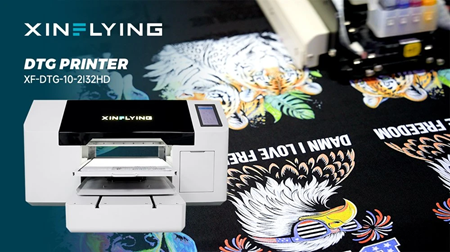
Switching smoothly between lightweight summer tees, heavyweight unbleached sweatshirts, and woven cotton tote bags requires a DTG platform with rigid platen mechanics and reliable vertical height adjustment. Print shops evaluating versatile commercial units such as the XINFLYING XF-DTG-10—or comparing multi-head dual-platen systems like the XF-DTG-20 and heavy-duty XF-DTG-380—can review the complete lineup of XINFLYING DTG printing machines to match platen flexibility and white-ink circulation capacity to their textile product mix.
By pairing a precision-adjusted platform like the XINFLYING XF-DTG-10 with dedicated bag platens and high-pressure pre-press fibre flattening, textile decorators can produce vibrant, durable water-based prints across heavyweight unbleached cotton and canvas product lines.